
Shenzhen Zhenghao Plastic & Mold Co.,Ltd
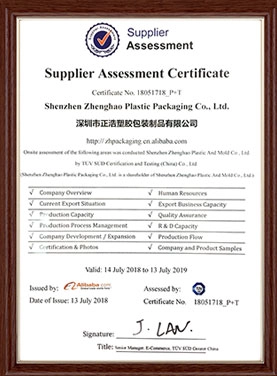
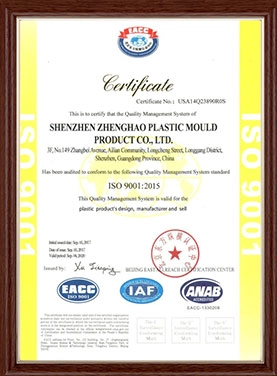
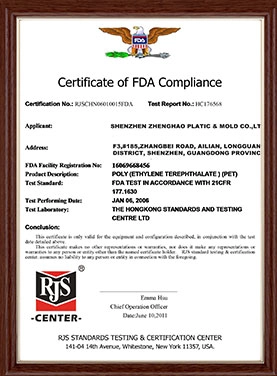
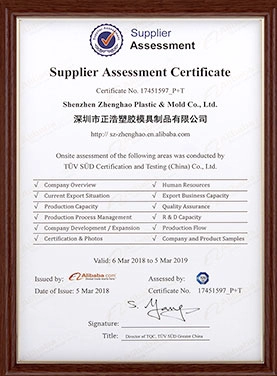

Tem No: zh-mb004 Capacity: 250ml 350ml 400ml 500ml 1000ml Material: PET Shape: round Used for: shampoo packaging Place of origin: Shenzhen, China MOQ: 5,000 pieces Unit price range: $0.3-0.6 Sample: available, free, client pay for sample shipping cost

Tem No: ZH-C70244 Capacity: 1L Material: 500ml 2L 4L Used for: detergent liquid bottle Place of origin: Shenzhen, China MOQ: 5,000 pieces Unit price range: $0.32-$0.48 Sample: available, free, client pay for sample shipping cost

Tem No: zh-p9309 Capacity: 2L Material: HDPE Shape: Round Used for: detergant liquid Place of origin: Shenzhen, China MOQ: 5,000 pieces Unit price range: $0.32-$0.48 Sample: available, free, client pay for sample shipping cost

Tem No: zh-c70231 Capacity: 1L Material: HDPE Shape: Round Used for: detergant liquid Place of origin: Shenzhen, China MOQ: 5,000 pieces Unit price range: $0.32-$0.48 Sample: available, free, client pay for sample shipping cost

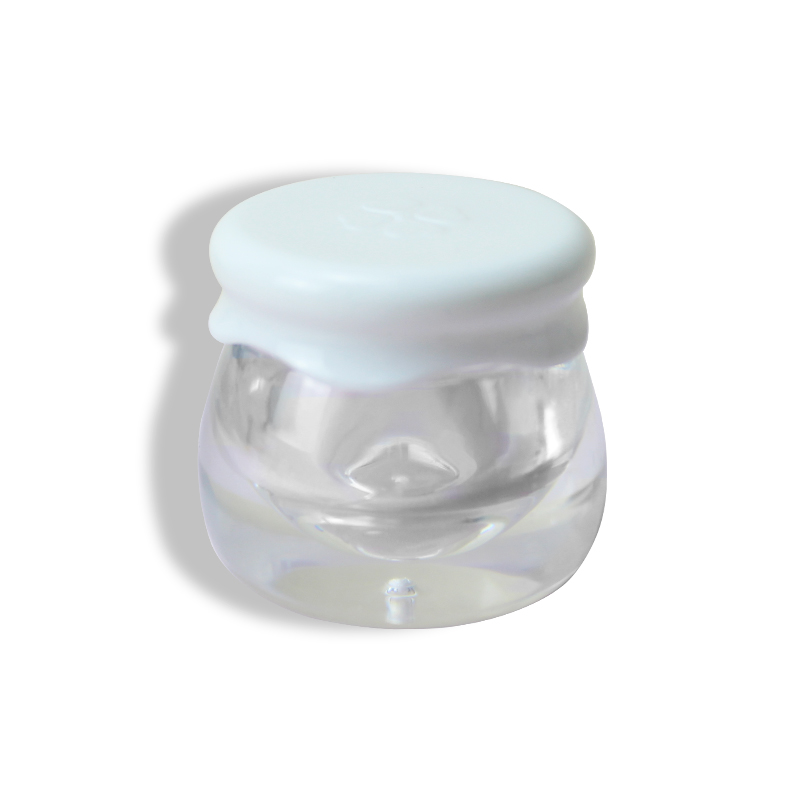
PP (Polypropylene) plastic containers are increasingly popular in the cosmetic and skincare industries, particularly for small-capacity products like creams, eye creams, and eyeliner gels.

plastic drink bottles factory, China cosmetic plastic bottles, disposable plastic bottle suppliers, plastic pet bottles manufactures, plastic bottles for lotion manufactures

customized color plastic bottle with pump 300ml 400ml 500ml round pet bottle for skincare plastic lotion bottle


HDPE Custom Eco PCR Recycled Plastic Bottle Body Tanning Oil 60ml Travel Size Squeeze Bottle Cosmetics


New female urine bottle. Equipped with a patented leak-proof cover to block urine leakage and avoid embarrassment. Currently, men's urine bottles are ...

These large empty pump bottles are ideal when you don’t want ugly or messy detergent bottles laying around. They are great for business use / work si...

Zhenghao Plastic & Mold Co.,Ltd had developed a new materia named HDPE sand blasting matieral, that is double layer bottle construction. The final bo...
If you are a brand owner or packaging developer, you have probably held a PET wine bottle and thought: this still feels like plastic. The clarity is off. The surface has tiny waves. It looks exactly like what it is – a container trying to look like glass but failing.
That gap is not inevitable. Over the past five years, a combination of process control, mold surface engineering, and post-mold coatings has closed the visual and tactile distance between high-end plastic wine bottles and glass. This article walks through the actual techniques that work, the defects you must avoid, and what to check before placing your next order for custom bulk wine bottles.
What ''Glass-Like'' Actually Means in Packaging – And Why It Matters?
Let us be precise. If plastic bottles are to replace glass bottles, they must retain some of the characteristics of glass, while also having the unique advantages of plastic.
♦Clarity – no haze, no yellow tint, and high light transmission (above 90% for PET at 560nm is a reasonable benchmark).
♦Surface gloss measured by a gloss meter at 60°, a glass-like surface typically exceeds 85 GU (gloss units), whereas standard unpainted PET moldings often sit at 70–75 GU.
♦Tactile smoothness no ''drag'' when you run a finger across. Glass has a unique low-friction, cool feel. Plastic can mimic the smooth part but not the thermal conductivity – and that is fine. The goal is visual and tactile consistency.
Why does this matter for wine? Because wine is as much about perception as flavor. A bottle that looks cheap signals a cheap product inside, regardless of the actual wine quality. For brands moving from glass to 750ml plastic wine bottles, losing the premium look is a dealbreaker.
Technique 1: Injection Stretch Blow Molding + Mold Texturing – The Foundation You Cannot Skip
The single biggest factor for glass-like clarity is not a coating. It is the base manufacturing process.
Standard extrusion blow molding produces a weld line and uneven wall distribution. That kills clarity. The correct process for high-clarity custom plastic wine bottle production is injection stretch blow molding (ISBM) .
How ISBM works (briefly):
♦A preform is injection molded with precisely controlled wall thickness.
♦That preform is reheated and stretched axially while blown radially.
♦The biaxial orientation aligns polymer chains, which reduces crystallite size – smaller crystals scatter less light, hence better clarity.
Practical insight from the shop floor:
A poorly designed preform will ruin clarity even on the best ISBM machine. The key variable is the preform inner and outer wall profile. Many plastic wine bottle manufacturer quotes skip this detail. Ask for the preform design file and the simulated wall thickness distribution. A uniform wall (within ±0.15mm) is the difference between a glass-like bottle and a streaky one.
Mold texturing – often misunderstood. If you want a smooth, glass-like surface, do you use a mirror-polished mold cavity? Not always. A mirror polish (SPI A-1) can cause part sticking and visible flow marks because there is nowhere for the trapped air to escape. The better approach: a fine matte or ''orange peel'' texture (SPI B-1 or B-2) that still releases easily while reading as optically smooth to the naked eye. This counterintuitive choice is common among experienced mold makers but rarely explained to buyers.
Technique 2: Specialty Spray Coatings – Where Ice Crystals and Frosted Finishes Come From
Raw ISBM PET can achieve clarity, but it cannot achieve patterned effects like ice-crystal textures or uniform matte/satin finishes without post-mold treatment.
Two coating families dominate:
1.Plasma-enhanced chemical vapor deposition (PECVD) coatings – a nanometer-thin glass-like layer (SiOx) that increases surface hardness and changes gloss. This is how some plastic wine bottles wholesale suppliers offer ''glass-coated plastic.'' It works, but it adds 15–20% to unit cost.
2.UV-curable spray coatings – the workhorse for decorative effects. By controlling the spray droplet size (30–50 microns) and the resin's flattening agent concentration, you can produce:
♦Ice-crystal patterns – achieved with a two-layer system: a smooth base coat plus a textured top coat that shrinks differently during curing.
♦Frosted/matte touch – silica-based flatteners create micro-roughness that scatters light. The human fingertip perceives this as smooth but not glossy – very close to etched glass.
A performance warning from ASTM D3359 (adhesion testing):
Many decorative coatings fail adhesion after 3–5 dishwasher cycles or prolonged refrigeration. If your plastic bottles for wine will be used in ice buckets or sold as reusable decanters, insist on a cross-hatch adhesion test (ASTM D3359 Method B) with a 4B or 5B rating. Most standard cosmetic-grade coatings are not designed for wet-cold cycling.
Avoiding the''Plastic Cheap'' – Three Critical Defects to Catch Before Production
You can have the right process and the right coating, but three visual defects will still scream “Cheap.
1. Uneven wall thickness
Visible as''burn lines'' or ''color cloud'' when you hold the bottle to light.
Root cause: preform temperature profile off, or stretch rod speed mismatched.
What to ask your supplier: “What is your wall thickness tolerance on 750ml plastic wine bottles? May I see a cross-section cut of the first sample?”
2. Flow marks (also called ''flow line'' or ''hesitation marks”)
Wavy patterns near the base or shoulder.
Root cause: melt front cools prematurely during injection.
Mitigation: higher mold temperature (above 50°C for PET) and a larger gate diameter. Many custom plastic wine bottle orders skimp on gate size to save tooling cost – that is a mistake.
3. Stress whitening (also called ''blush'' or ''crazin'')
White discoloration that appears when you squeeze the bottle or near the neck after capping.
Root cause: molecular orientation frozen under tension.
Solution: annealing (heat soaking) post-mold at around 120–130°C for 2–3 seconds. Not all plastic wine bottle manufacturer lines include this step. Verify it.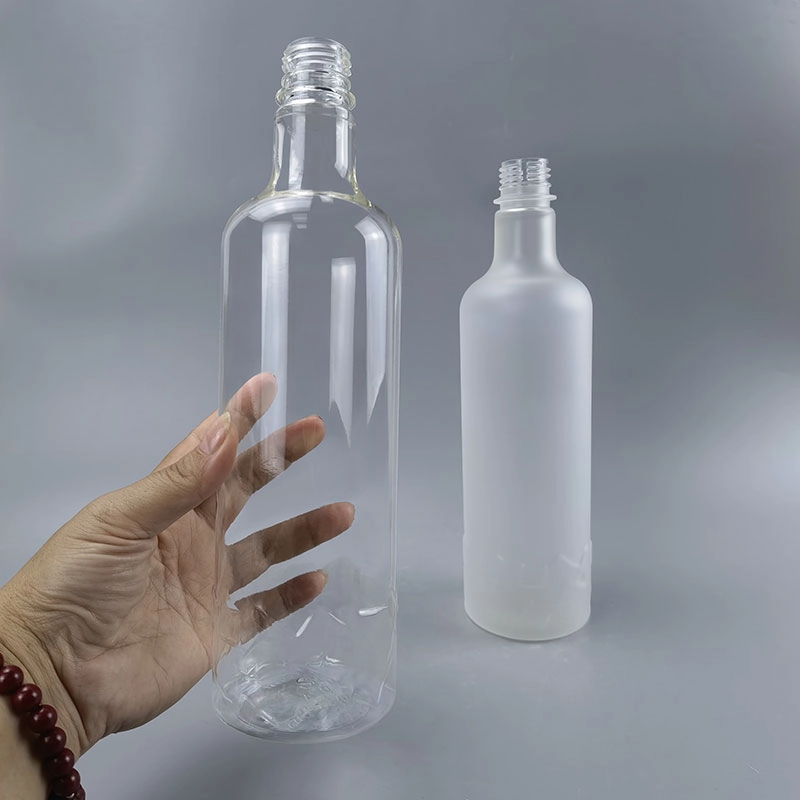
The above three technical flaws are common problems that occur in practice. Zhenghao, during his 20 years production period, has avoided these issues by enhancing the technical skills of the workers and adopting more advanced production machinery and a comprehensive quality inspection process. However, when you customize plastic wine bottles, you must pay attention to these several issues.
Key Considerations When Selecting a Plastic Wine Bottle
Use this checklist when evaluating samples or bids from plastic wine bottles wholesale suppliers:
♦Intended fill temperature: Hot fill (above 70°C) requires heat-set PET. Room-temperature wine does not.
♦Clarity requirement: Optical grade? Then insist on ISBM with preform wall simulation report.
♦Leakage prevention test: The leakage prevention test needs to be conducted in a vacuum environment.
♦Coating durability: Ask for ASTM D3359 tape test results after 48h water soak.
♦Drop test standard: ISTA 1A is minimal. For e-commerce, request ISTA 6‑Amazon or equivalent.
♦Recyclability: A coated bottle may not be compatible with standard PET recycling streams. If your brand is sustainability-driven, consider uncoated high-gloss ISBM instead.
♦MOQ trade-off: Custom mold tooling for a custom plastic wine bottle starts at 300-1000 usd for a single cavity. For smaller runs, a stock 750ml plastic wine bottle with post-mold spray coating can deliver 80% of the visual effect at 20% of the tooling cost.
Regulatory and Standards Context – Brief but Useful
Two references you can rely on when negotiating with suppliers:
ASTM D4603 – Standard test method for determining inherent viscosity (IV) of PET. A higher IV (0.80–0.85 dL/g for stretch blow molding) correlates with better mechanical strength and clarity. Ask your plastic wine bottle manufacturer for the resin IV.
FDA 21 CFR 177.1630 – Lists PET and copolyesters approved for food contact. If you import bulk wine bottles, ensure a valid FDA letter of guarantee, especially for recycled PET (PCR).
These are not theoretical. Non-compliant bottles have been held at customs for months.
FAQ – Practical Answers for Customer
1. Can a plastic wine bottle truly look identical to glass from 30 cm away?
Yes – with ISBM and a high-gloss mold finish (SPI A-2 or B-1). From typical shelf distance, most consumers cannot tell. The difference appears under direct sidelight or when holding both in hand.
2. Does a glass-like coating make the bottle more expensive than glass?
No. Even a coated 750ml plastic wine bottle is usually 30–50% lighter and ships with zero breakage loss. The total landed cost (bottle + freight + insurance) is lower than glass in most regions beyond 1000 km from the filling line.
3. How do I check if a sample bottle has stress whitening?
Squeeze the bottle firmly at the shoulder and base. If white marks appear and do not disappear within 5 seconds, the annealing step was inadequate.
4. Are these surface treatments dishwasher-safe?
Only if specified. Standard decorative spray coatings are not dishwasher-safe. Look for “top-rack dishwasher safe” certification – this usually means a plasma coating or a specialized two-part epoxy-acrylate hybrid.
5. What is the realistic MOQ for a custom surface texture (e.g., ice-crystal pattern)?
For a spray-applied pattern, MOQs can be as low as 5,000–10,000 units because it is a post-mold process. For a texture molded into the tool steel (permanent), the MOQ is the same as the bottle MOQ – typically 30,000–50,000 pieces to amortize the texturing service on the mold cavity.
Final thought for procurement managers:
Plastic wine bottles will never have the thermal feel of glass. That is a physical limit. But the visual and tactile gap has effectively closed for PET bottles using ISBM with precision mold texturing, optionally followed by a specialty UV coating. The real risk is not the technology – it is ordering from a plastic wine bottle manufacturer that does not control wall uniformity or annealing. Ask the right process questions before you approve samples.
 français
  Deutsche
  русский
  Español
  Italian
  português
  Nederlands
  Ελληνικά
  简体中文
简体中文  Polskie
  Czech
Czech